

Building a Milwaukee Icon
- Dec 26, 2025
- 6 min read

During the past five years the Harley-Davidson Motor Company has had a new building under construction practically all of the time. As soon as one was finished another was started. While the contractors were finishing the upper floors the lower floors were being used for manufacturing.” — The Harley-Davidson Dealer, January 1913
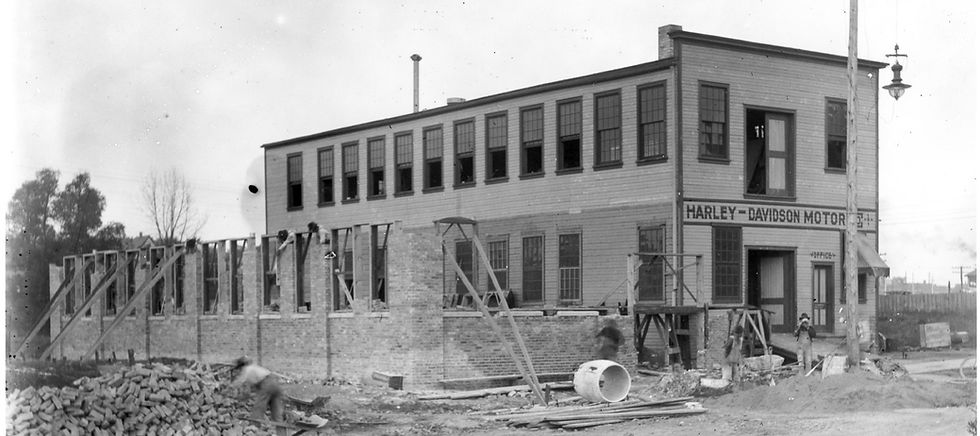
The Harley-Davidson Motor Company began in a small shed behind the Davidson family home in Milwaukee, Wisconsin. In 1906, the founders built a one-story factory one block north (pictured, above) on Chestnut Street. As multiple additions struggled to keep up with demand, that first factory was absorbed by the larger buildings that stand on the Juneau Avenue site today. (Chestnut Street became Juneau Avenue in 1931.)

Harley-Davidson has continuously occupied its original factory site since the buildings were first constructed. By 1918, the familiar red bricks of what is now Harley-Davidson’s corporate headquarters were in place. The functions have changed over the past century, but the buildings remain intact, a testament to the vision of the company’s founders.


The first buildings of a new modern factory were completed in 1910. The new five-story, brick structure, built in two stages and identified as Buildings No. 3 and 4, soared over the earlier factory. Those two original buildings (to the right) would be gone within three years, making way for larger additions.
The Motor Company focused on “providing the best possible working conditions for its employees” in constructing its new factory. The design incorporated plenty of windows to provide ample light and ventilation, and numerous details to make the building “absolutely fireproof.” The founders hired renowned Milwaukee architect A.C. Eschweiler to develop the plans.



Building No. 5
The increasing number of women within the work force had a concrete impact on the factory. When this building was constructed, the company included a large “Girls’ Rest Room,” then a relatively uncommon feature for Milwaukee factories.


Why That Shape?
Even as the factory was under constant construction, Harley-Davidson® motorcycle sales tripled between 1910 and 1912. The founders employed a variety of means to keep up the manufacturing pace. The shape of Building No. 5 reflects one unique solution: the company purchased the nearby Buchman Mfg. Co. factory, moved the entire building to an interior location, and made it operational while they built around it.

The Buchman Mfg. Co. building was originally located at 37th and Chestnut (next to the pre-1910 factories). In March 1912, it was moved approximately 100 feet to the north of its original location to make way for Harley-Davidson's new Building No. 5. The L-shaped construction of this factory addition allowed plenty of natural light from all sides. As soon as the addition was completed, the Buchman building was torn down to make room for a rear receiving yard to accommodate wagon shipments.


Building No. 6
The second new factory addition of 1912 occupied the space upon which the first factory was built (adjacent to Building No. 3 with the Bar and Shield logo). Commenting on the incredible growth in motorcycle sales, the company’s new publication, "The Harley-Davidson Dealer," noted “…the entire factory used by the Harley-Davidson Motor Company in 1908 has now been torn down to make room for a larger structure. No better example has come to our attention to demonstrate the importance and the permanency of the motorcycle industry.”
Construction on Building No. 6 began in October and was completed by December 1912. The work was accomplished by crews working day and night to complete the reinforced concrete structure on time. "Busy is no name for it around here this season." — The Harley-Davidson Dealer, October 1912


Bridging the Gap, and the Railroad
The 1913 factory addition (Building No. 7) completed the wedge-shaped building that commands the site today, bridging the gap between segments built over the past three years. This final section included a north-side dock and elevator directly connected to the shipping and receiving areas. The proximity to the railroad line was critical to the factory operations, bringing in materials and shipping out completed motorcycles.
Building No. 8
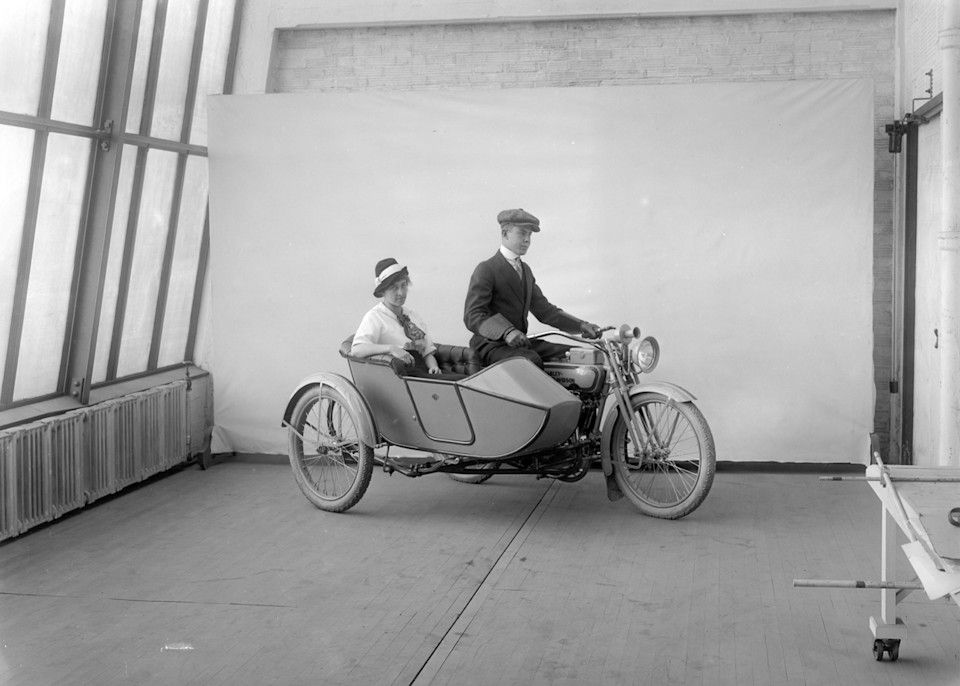
In 1913, Harley-Davidson built a spacious photo studio on the factory roof. The location, with a large wall of north facing windows, let in ample amounts of natural light—perfect for product photography. Upon its completion, Harley-Davidson boasted of having “the most completely equipped commercial photograph studio and darkrooms west of New York


Industrial Necessities
The operations of the growing Harley-Davidson factory required tens of thousands of gallons of gasoline, fuel oil, and lubricating oil. Huge tanks were sunk on the factory grounds to store these vital fluids. Also buried within the structures were the boilers that generated steam for heat and power. A complex system of pipes and tunnels kept the right things flowing to the right places.


Expansion—Building No. 9
Factory construction took a break after the feverish schedule of 1910-1913. The company spent a few years consolidating and refining operations before breaking ground on a building to house a new breed of “automatic machines.” Manufacturing technology was evolving quickly during this period, and machines were now automating some formerly manual operations. This 1918 building was thus referred to as the “Automatic Shop.”


Building No. 11
Construction of the six-story Building No. 11 on the south side of Chestnut Street (now Juneau Avenue) in 1920. The photo was taken across Highland Boulevard. The large house to the right of the construction site was used as the Harley-Davidson Sales School.
Completing the Second Factory Complex
By 1921, the construction of the Juneau Avenue factory campus as we know it today was largely complete. Three smaller building projects between 1921 and 1926 would fill out the factory and bring Harley-Davidson’s building boom to a close.

Depictions of the completed factory were used in marketing materials, including this spread in The Harley-Davidson Enthusiast™ magazine. The company publications had shared detailed campus construction updates within their pages. Note: This stylized rendering does not represent the actual factory accurately: the east side of main building is larger, and Building No. 11 comes right up to Highland Avenue, among other liberties taken.

Today
Construction through the 1910s created the buildings that today, a century later, remain the proud home of Harley-Davidson. Motorcycle production at Juneau Avenue ceased in 1973, and the buildings were converted to serve as an expanded corporate headquarters. In 1994, they were added to the National Register of Historic Places. These historic structures are a visible, active tie to Milwaukee’s proud industrial heritage.

Written by The Harley-Davidson Museum
Pictures by courtesy of The Harley-Davidson Museum


Comments